Ruthenium Recovery & Refining
Ruthenium is a hard, versatile Platinum Group Metal used in electronics, hard-disk media, and electrochemistry. Viyanmani recovers ruthenium from electronic scrap, spent catalysts, and chemical residues.
What is Ruthenium?
Ruthenium (Ru, atomic number 44) is a hard, brittle Platinum Group Metal that resists corrosion and dramatically hardens platinum and palladium alloys even in small amounts.
It is widely used in electronics, perpendicular magnetic recording media, dimensionally stable anodes, and emerging catalysis.
Ruthenium is recovered as a by-product of platinum refining, so secondary recovery is an important supplementary supply route.
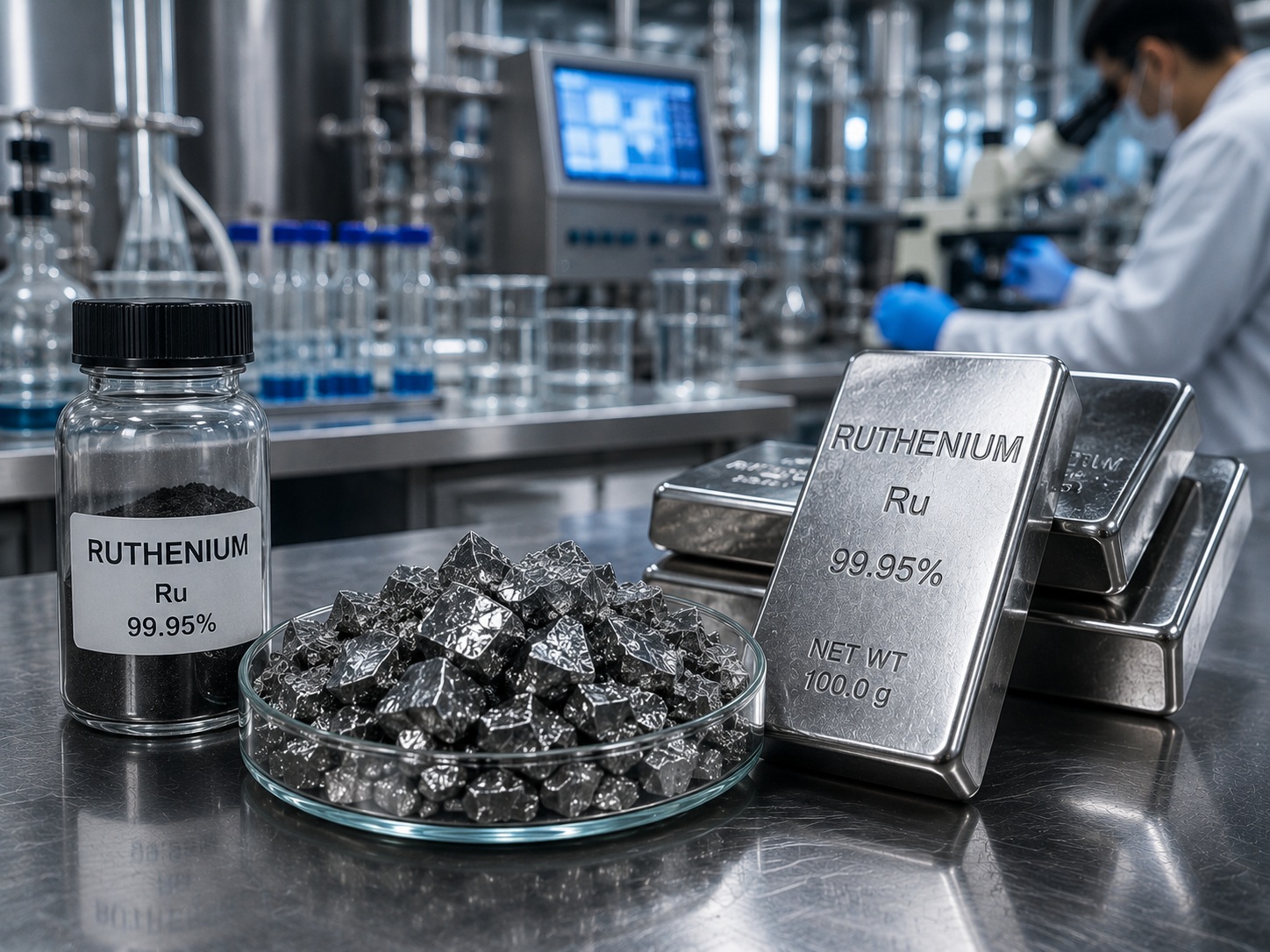
Industries using Ruthenium
Ruthenium applications
- Thick-film resistors and electrical contacts
- Perpendicular magnetic recording layers in hard drives
- Dimensionally stable anodes for chlor-alkali electrolysis
- Ammonia synthesis and Fischer–Tropsch catalysts
- Wear-resistant electrical and electronic coatings
Recovering and refining Ruthenium
Our integrated route recovers Ruthenium from secondary materials and refines it to 99.9%+ purity.
Recovery Process
Ruthenium-bearing electronic scrap, spent catalysts, and residues are sampled and processed so ruthenium is captured into the recoverable concentrate rather than volatilized or lost during upstream treatment.
Extraction Process
Ruthenium is brought into solution through controlled oxidation chemistry. Because ruthenium can form a volatile oxide, dissolution and capture are managed within enclosed systems to prevent loss and ensure safety.
Recycling Process
Recycling returns ruthenium from end-of-life electronics and spent industrial catalysts to refined metal and compounds, supplementing a supply that depends heavily on platinum-mining by-product output.
Purification
Ruthenium is selectively separated from other PGMs through distillation and precipitation chemistry, then reduced to high-purity powder and verified analytically.
Why refine Ruthenium with Viyanmani
- Safe, enclosed handling of ruthenium's volatile oxide chemistry
- Recovery from complex, low-grade electronic feed
- High-purity refined ruthenium powder and compounds
- Transparent assay-based valuation
Ruthenium and sustainability
- Recovers a by-product metal with a constrained primary supply
- Diverts valuable material from electronic-waste streams
- Supports resource efficiency in electronics and green-chemistry sectors
Ruthenium questions, answered
Common questions about how Ruthenium is recovered, recycled, and refined.
Ruthenium is used in electronics (thick-film resistors, contacts), hard-disk recording layers, chlor-alkali anodes, and catalysis for ammonia synthesis and Fischer–Tropsch chemistry. Small additions also harden platinum and palladium alloys.
Other metals we refine
Recover Ruthenium from your materials
Talk to our specialists about recovering and refining Ruthenium from your spent catalysts, scrap, or residues.