Palladium Recovery & Refining
Palladium is a lightweight, highly catalytic Platinum Group Metal essential to gasoline emission control, electronics, and hydrogen purification. Viyanmani recovers palladium from autocatalysts, multilayer ceramic capacitors, and process residues.
What is Palladium?
Palladium (Pd, atomic number 46) is the least dense and lowest-melting of the six Platinum Group Metals, with remarkable hydrogen-absorption and catalytic properties.
It is the primary active metal in three-way catalytic converters for gasoline engines and a critical material in multilayer ceramic capacitors (MLCCs).
Palladium demand consistently outpaces primary supply, making end-of-life recovery economically and strategically vital.
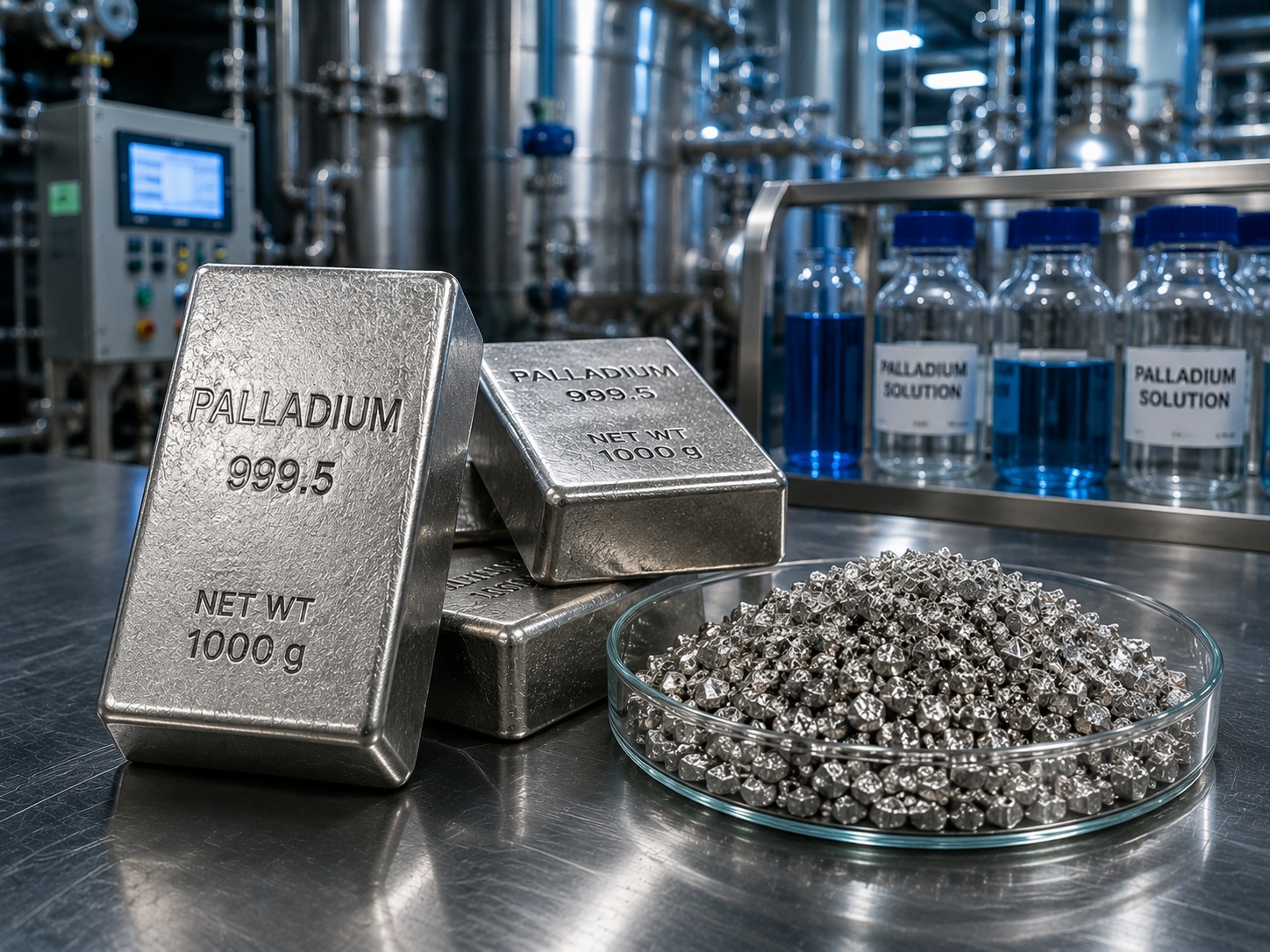
Industries using Palladium
Palladium applications
- Three-way catalytic converters for gasoline vehicles
- Multilayer ceramic capacitors and electronic contacts
- Hydrogenation and cross-coupling catalysts in pharmaceuticals
- Hydrogen purification membranes
- White-gold alloys and dental restorations
Recovering and refining Palladium
Our integrated route recovers Palladium from secondary materials and refines it to 99.95%+ purity.
Recovery Process
Palladium-bearing feed — spent autocatalysts, electronic components, and spent process catalysts — is assayed by XRF and homogenized. Pyrometallurgical collection concentrates palladium alongside other PGMs into a recoverable metallic phase.
Extraction Process
The concentrate is dissolved and palladium is selectively taken into solution. Because palladium chemistry differs from platinum and rhodium, tailored complexation allows it to be separated cleanly from the wider PGM stream.
Recycling Process
Recycling returns palladium from vehicle catalysts and electronics to fresh catalyst and capacitor manufacture. This closed loop reduces reliance on volatile primary supply and keeps a scarce metal in continuous productive use.
Purification
Palladium is precipitated as a high-purity salt using selective reagents, then reduced to sponge. Final metal is validated by ICP-OES to confirm 99.95%+ purity before settlement.
Why refine Palladium with Viyanmani
- High-yield recovery from low-concentration electronic scrap
- 99.95%+ refined purity with certificate of analysis
- Rapid, transparent settlement on assayed metal value
- Secure logistics for high-value palladium consignments
Palladium and sustainability
- Recovers a metal whose mining is a by-product of energy-intensive nickel and platinum extraction
- Reduces pressure on constrained primary palladium supply
- Prevents valuable metal from being lost to landfill in discarded electronics
Palladium questions, answered
Common questions about how Palladium is recovered, recycled, and refined.
The largest secondary source is spent gasoline autocatalysts, followed by electronic scrap such as multilayer ceramic capacitors, and spent chemical and pharmaceutical process catalysts.
Other metals we refine
Recover Palladium from your materials
Talk to our specialists about recovering and refining Palladium from your spent catalysts, scrap, or residues.